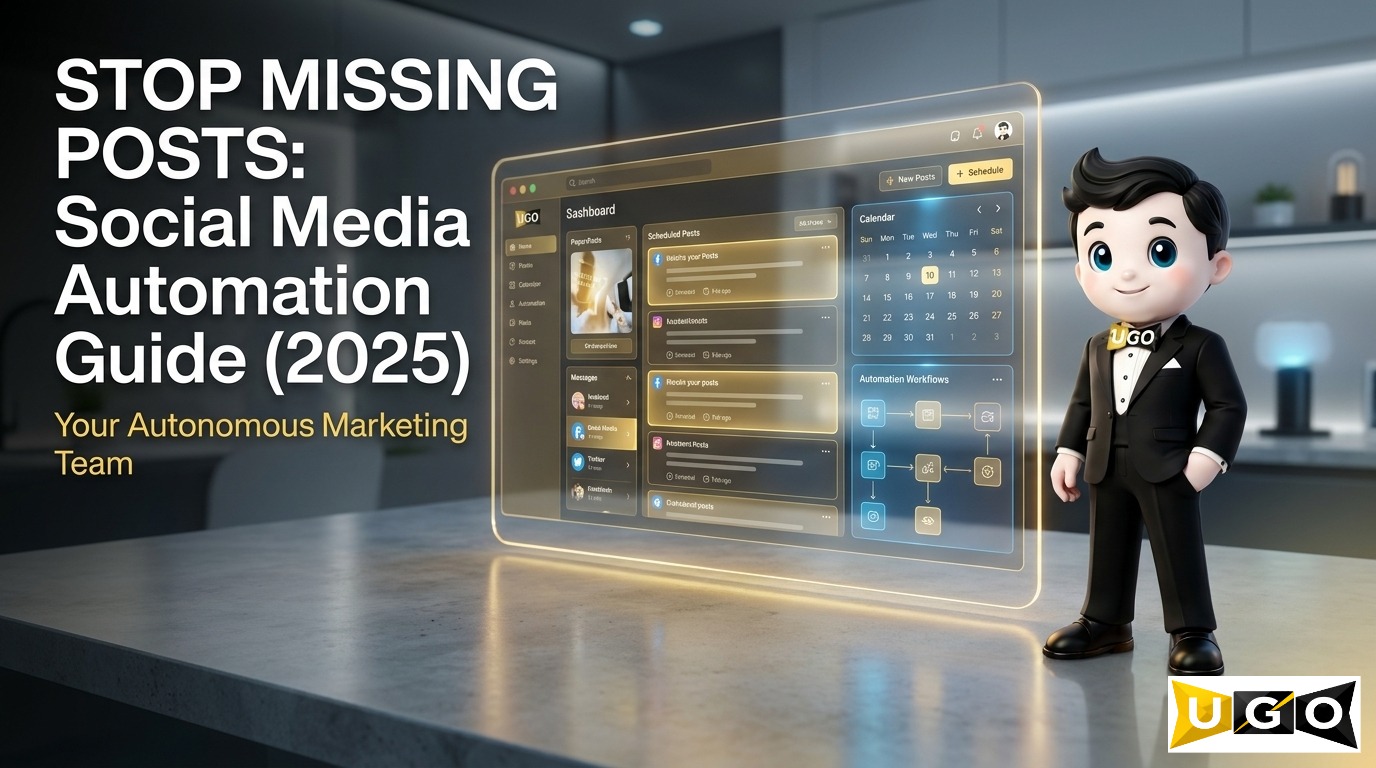
Stop Missing Posts: Social Media Automation Guide (2025)
Stop Missing Posts: Social Media Automation Guide
Social media automation involves using software to schedule posts, curate content, and manage engagement across platforms like Facebook, Instagram, and LinkedIn. It ensures consistent delivery, prevents "missing" posts due to manual fatigue, and leverages AI to maintain high-quality presence without constant human intervention, allowing teams to focus on strategy rather than execution.
1. Introduction: The High Cost of 'Missing' Posts and Manual Fatigue
In the fast-paced digital landscape of 2025, a missing post is more than just a gap in your feed; it is a missed opportunity for conversion, a dip in algorithmic favor, and a signal to your audience that your brand may be losing its momentum. For business owners and marketing agencies, the pressure to remain "always-on" leads to a state of manual fatigue. This fatigue often manifests as late-night posting, rushed captions full of typos, or worse—entire days passing without any brand activity because the person in charge was simply too busy. When you miss a post, you aren't just losing visibility for that day; you are breaking the promise of consistency you made to your followers.
Manual posting is fundamentally unscalable. As your brand grows or your agency takes on more clients, the number of platforms, time zones, and content formats increases exponentially. Trying to manage this manually is like trying to hold back a flood with a bucket. The mental load required to remember that an Instagram Reel needs to go live at 2 PM on Tuesday while a LinkedIn article needs to drop at 9 AM on Wednesday is exhausting. This cognitive load detracts from high-level creative thinking and strategy, trapping marketing professionals in the weeds of execution rather than the heights of innovation.
The solution to this "missing post" epidemic is a robust Stop Missing Posts: Social Media Automation Guide. By shifting from a manual reactive model to an automated proactive model, you regain control over your time. Automation isn't about removing the human element; it's about providing a safety net that ensures your brand remains active even when you are offline. This guide will walk you through the technical nuances, strategic frameworks, and tool selections necessary to build a truly autonomous social media presence that works for you, not against you.
2. What is Social Media Automation? (Expanding the Definition Beyond Scheduling)
To many, social media automation is synonymous with scheduling. While scheduling is a core component, true automation encompasses the entire lifecycle of a social media post. It starts with content discovery and curation, moves through generation and optimization, handles the actual publishing, and concludes with automated engagement and performance reporting. It is the use of software to perform repetitive tasks with precision, ensuring that the right message reaches the right audience at the optimal time without a human having to click "send" every single time.
Modern automation now integrates Artificial Intelligence to bridge the gap between efficiency and quality. For example, autonomous systems can now analyze your brand's historical data to determine which hashtags are trending in real-time or which image styles generate the highest click-through rates. This means automation is no longer just a "dumb" tool that follows instructions; it is an intelligent partner that optimizes content on the fly. This evolution is critical for staying competitive as platform algorithms become more sophisticated and demand higher standards of content relevance.
Furthermore, automation extends into the realm of community management. Automated DM responses, chatbot integrations, and social listening triggers allow brands to respond to inquiries in seconds. In a world where 79% of consumers expect a response to their social media queries within 24 hours, these automated systems are the difference between a happy customer and a lost lead. Understanding this broader definition is the first step toward implementing a system that truly replaces the manual grind.
3. The Reliability Pillar: Why Automated Posts Fail and How to Ensure 100% Delivery
The irony of automation is that it can sometimes lead to the very problem it seeks to solve: missing posts. We call this the "Ghost Post" technicality. A post is scheduled, the user assumes it’s taken care of, but the platform fails to publish it. The most common culprit is API token expiration. Platforms like Meta (Facebook/Instagram) and LinkedIn require you to "re-authorize" your connection to third-party tools every 60 to 90 days for security. If you ignore those notification emails, your connection breaks, and your posts quietly fail to go live.
Another technical hurdle involves media formatting. Each platform has strict requirements for aspect ratios, file sizes, and video bitrates. If you schedule a video that is 1MB over the limit or has an unsupported frame rate, the automation tool may reject it at the last second. To prevent this, your Stop Missing Posts: Social Media Automation Guide must include a pre-flight checklist. Always use tools that offer "Live Preview" features, which simulate how the post will look on the platform's native environment, flagging errors before they become failures.
To ensure 100% delivery, you should set up "Failure Alerts." Most professional automation platforms can send a push notification or an email the moment a post fails to publish. Additionally, utilizing an autonomous system like UGO, which manages the entire end-to-end workflow, reduces the friction between different tools, minimizing the points of failure. By auditing your platform connections monthly and ensuring your assets meet platform specs, you can eliminate the "Ghost Post" phenomenon entirely.

4. Core Workflows: 5 High-Impact Tasks You Should Automate Today
Automated Content Scheduling and Calendar Management
The cornerstone of any strategy is the content calendar. Automating this means moving beyond a spreadsheet and into a dynamic environment where posts are queued based on pre-defined categories. For instance, you can set a rule that every Tuesday is a "Customer Success Story" and every Thursday is an "Industry Tip." The automation tool then pulls from your library of assets and fills these slots, ensuring a balanced mix of content without you having to manually drag and drop every single tile.
Evergreen Content Recycling
One of the most efficient workflows is the "Drip Campaign" for evergreen content. Many of your best posts are timeless, yet they often get buried in your feed after 24 hours. Automation allow you to "recycle" these posts by re-adding them to your queue at set intervals (e.g., every 3 months). This ensures that new followers see your best work and maximizes the ROI of every piece of content you create. This is especially useful for blog promotions and high-value lead magnets.
AI-Assisted Caption and Hashtag Generation
Writer's block is a primary reason for missed posts. Modern automation tools integrate Large Language Models (LLMs) to generate dozens of caption variations based on a single image or link. Instead of spending an hour writing one caption, you can spend five minutes reviewing and approving five AI-generated options. Similarly, automated hashtag generators analyze current trends to ensure your post has the best possible reach, removing the guesswork from SEO-driven social posting.
5. Social Listening: How to Stop Missing Brand Mentions and Influencer UGC
Most guides focus on what you post, but missing what *others* post about you is equally damaging. Social listening is the automated monitoring of brand mentions, even when you aren't tagged. For example, if a customer tweets about your product but forgets to use your handle, traditional notifications won't help you. Social listening tools scan the entire platform for keywords related to your brand, competitors, and industry, aggregating them into a single dashboard for your review.
This is critical for discovering User-Generated Content (UGC). When a micro-influencer shares a positive review of your brand, automation allows you to capture that mention instantly. You can then automate the process of requesting permission to reshare that content, significantly boosting your social proof without manual searching. This proactive approach turns your social media from a megaphone into a two-way conversation, which is exactly what the algorithms reward with higher organic reach.
Furthermore, social listening acts as an early warning system. By automating alerts for negative keywords or sudden spikes in brand mentions, you can catch PR issues before they spiral out of control. In the context of a Stop Missing Posts: Social Media Automation Guide, social listening ensures you never miss a chance to engage with your most vocal fans and critics alike, maintaining a pulse on your brand's digital reputation around the clock.
6. Top Automation Tools for 2024-2025 (Categorized by Team Size & Budget)
Choosing the right tool is the difference between a streamlined workflow and a technical nightmare. For small business owners or solo entrepreneurs, tools like Buffer and Later offer user-friendly interfaces and free tiers that cover the basics of scheduling and basic analytics. These platforms are "cloud-based" (SaaS), meaning they handle all the server-side logistics, but they do offer less control over data privacy and custom integrations compared to other options.
Standard SaaS (Buffer, Hootsuite) Small Teams Ease of use, low setup time Self-Hosted (Mixpost) Privacy Conscious No monthly fees, data ownership Enterprise (Sprout Social) Large Agencies Deep analytics, CRM integration Autonomous (UGO) High Volume / Growth Hands-off generation & publishingFor marketing agencies managing dozens of locations, a more robust solution is required. This is where autonomous systems like UGO shine. Unlike traditional tools that require you to feed them content, autonomous systems can scan your brand DNA and generate the content itself. This removes the "creation bottleneck" entirely. If you are looking for maximum control, self-hosted platforms like Mixpost allow you to run your own social media server, which is excellent for compliance-heavy industries but requires technical expertise to maintain.
7. The Human-AI Hybrid: Using AI for Efficiency Without Losing Your Brand Voice
The biggest fear with automation is that your brand will start to sound like a robot. To combat this, we recommend the Human-in-the-Loop (HITL) Framework. This framework suggests a 70/30 ratio: 70% of your content can be fully automated (educational tips, curated news, evergreen reminders), while 30% must be high-touch, manual, or deeply edited by a human (opinion pieces, community spotlights, and real-time responses). This balance ensures you maintain the efficiency of automation without sacrificing the "platform DNA" that makes social media social.
When using AI for caption generation, use "Style Injection" prompts. Instead of asking the AI to "write a caption about social media," ask it to "write a caption about social media in the voice of a confident, direct marketing agency owner who values efficiency over fluff." By feeding the AI specific brand guidelines, the output becomes a tool for the human editor rather than a replacement for them. This iterative process ensures that the automated posts that go live are indistinguishable from those written by your best copywriter.
Automation should also handle the "dark work"—the tasks no one sees but everyone benefits from. This includes cross-posting, formatting images for different dimensions, and tagging products in posts. By letting the machine handle the technical drudgery, you free up your creative team to spend more time on the 30% of content that requires true human intuition and emotional intelligence. This hybrid model is the hallmark of a sophisticated 2025 marketing strategy.
8. Automation Mistakes That Kill Engagement (and How to Fix Them)
One of the most common mistakes is "Set it and Forget it" Syndrome. Just because a post is scheduled doesn't mean your job is done. If a post goes live and receives 50 comments in the first hour, and you don't respond because you're "off the clock," you are effectively telling the algorithm that you don't care about engagement. The fix? Use automated DM auto-responses to acknowledge commenters immediately, and set up push notifications for high-priority threads so you can jump in manually when needed.
Another pitfall is repetitive content. Posting the exact same link with the exact same caption across Facebook, Twitter, and LinkedIn simultaneously is a red flag for both users and algorithms. Each platform has its own culture. A post that works on LinkedIn needs a more professional tone and perhaps more data points, whereas the same content on Instagram needs a visual-first approach and conversational language. Use automation tools that allow for "Customized Platform Previews," where you can tweak the caption for each network within the same scheduling window.
Finally, ignoring time zones is a classic error. If your headquarters are in New York but 40% of your audience is in London, posting solely on Eastern Time means you are missing your UK audience entirely. Advanced automation tools use "Optimal Timing" algorithms that analyze when your specific followers are most active. Instead of choosing a time yourself, let the machine pick the slot that maximizes the likelihood of your post being seen and interacted with. This is a simple but powerful component of any Stop Missing Posts: Social Media Automation Guide.
9. The 'Kill Switch' Strategy: Managing Automation During a Crisis
Nothing damages a brand faster than a cheerful, automated promotional post going live during a national tragedy or a PR crisis. This is why every automation strategy must include a "Crisis Kill Switch" protocol. This is a documented, one-click process that pauses all scheduled content across all platforms. Whether it's a real-world event or a specific issue within your industry, you must have the ability to go dark instantly to avoid appearing tone-deaf or insensitive.
Beyond national crises, you should also have a protocol for internal PR issues. If your brand is currently dealing with a product recall or a public controversy, your standard "business as usual" automation can exacerbate the situation. A kill switch allows your team to huddle, assess the situation, and decide which automated posts can stay and which need to be pulled. This level of control is what separates professional automation from amateur "spray and pray" tactics.
Implementation is simple: most top-tier social media management tools have a "Pause All" button prominently displayed in the dashboard. Ensure that multiple team members have access to this button and know the specific criteria for when it should be pressed. Having a pre-written "status update" post ready to go—explaining that you are pausing content out of respect or to address an issue—further demonstrates brand maturity and responsibility.
10. Audit Checklist: A Monthly Routine to Optimize Your Automation Stack
Automation is not a permanent solution; it is an ongoing process that requires regular maintenance. To ensure your Stop Missing Posts: Social Media Automation Guide remains effective, implement a monthly audit. The first step is to check all API connections. Re-authorize any tokens that are nearing their expiration date to prevent those "Ghost Posts" we discussed earlier. This five-minute task can save you hours of troubleshooting later in the month.
Next, review your performance analytics. Are your automated posts performing as well as your manual ones? If not, examine the content. Perhaps the AI-generated captions have become too repetitive, or the posting times are no longer optimal. Use this data to refine your automated workflows. For example, if your "Evergreen" posts are seeing a decline in engagement, it might be time to swap them out for new assets or adjust the frequency of the recycling loop.
Finally, audit your team workflows. Is the approval process still working, or is it creating a bottleneck that leads to missed deadlines? If posts are frequently being approved at the last second, consider moving your content creation window up by a week. By treating automation as a dynamic system rather than a static tool, you ensure that your social media presence continues to grow and adapt alongside your business objectives.
11. Conclusion: Building a Sustainable, Hands-Off Social Strategy
The journey to stop missing posts isn't about working harder; it's about working smarter through strategic automation. By understanding the common points of failure—from API tokens to tone-deaf scheduling—you can build a system that is both resilient and authentic. Automation is the bridge that connects your marketing strategy to its execution, ensuring that your brand's voice is heard consistently across every platform that matters to your audience.
As you move forward, remember that the most successful brands in 2025 are those that leverage technology to enhance their humanity, not replace it. Use the tools, frameworks, and checklists provided in this guide to reclaim your time and focus on what truly moves the needle for your business. Whether you are a small business owner or an agency managing a complex portfolio, the right automation stack is your greatest competitive advantage in an increasingly crowded digital world.
Ready to Get Started?
UGO replaces your marketing team, agency, and content workflow with a fully autonomous system that builds, plans, and publishes your marketing in minutes.
Visit Our Homepage